
Media Resources
Giving every AI agent photographic memory.
What is Memvid
Memvid is a memory layer for AI agents. We make it easy for developers to replace complex RAG pipelines with a single portable file that gives every agent instant retrieval and long-term memory.
Our Story
Memvid began as a late-night experiment by two friends who were just trying to solve a very real internal problem.
Saleban Olow (CTO) was working at an HR technology company, and Mohamed Mohamed (CEO)'s family ran a healthcare business. Both saw the same crisis from different angles: the growing staffing crisis.
To help, we built an AI agent that could screen applicants and understand the unique needs of the industry. But we quickly ran into two major issues:
1. AI memory was completely unreliable: Our agent kept forgetting critical context, hallucinating details, and losing track of who was who.
2. The data was extremely sensitive: We needed memory that could run fully on-prem, be portable, private, offline, and essentially unhackable.
So we tried something weird: One weekend we hacked together a prototype by storing embeddings inside video frames. We shared it with a few friends. They told us to open-source it.
And then everything exploded: 10M+ views, 10k GitHub stars, and thousands of developers building on top of it.
Six months later, that internal fix for a healthcare staffing problem became Memvid: the memory layer we've been dreaming about since day one.
We're not just fixing RAG. We're inventing a totally new memory format for AI.
Our Mission
To make AI memory simple, portable, and universal so every AI agent on the planet can remember forever without complex infrastructure.
We believe a single portable memory file will become a new standard, just like SQLite did for databases.
Company Details
- Company Name
- Memvid, Inc.
- Founded
- 2025
- Headquarters
- USA
- Website
- https://memvid.com
How Memvid Works
With a single portable file your AI agent instantly gets fast semantic search, perfect keyword recall, timeline and context memory.
The core is something we call Smart Frames. A Smart Frame is a self-contained semantic object: it holds the raw content, its embeddings, tags, timestamps, and the relationships it has to other frames.
All these frames live together in a single file that acts like a compressed memory graph. So your data is not just saved, it's understood, indexed, connected, and ready for immediate recall.
And because the structure is precomputed at write time, queries don't run a pipeline. There's no embedding call, no index lookup, no reranker stage. Memvid just activates the frames that match your question, by meaning, by keyword, by time, or by relational context, and reconstructs the answer instantly.
Key Features
Key Metrics
157 docs/sec
Ingestion Speed
Could ingest all of Wikipedia in half a day
<17ms
Search Latency
A blink takes 150ms
+60% better
Retrieval Accuracy
vs traditional RAG pipelines
15x
Compression
Smaller storage footprint
80-93%
Cost Savings
Lower storage cost
20 hrs/week
Dev Time Saved
Per developer
Why Developers Love Memvid
Replace your entire RAG stack
Retrieval in milliseconds
Store any file type
Works fully offline
Saves 20+ hours/week
Cuts costs by up to 90%
Compatibility
Works with Every Major Model
Integrates With
Pricing Overview
Free
Self hosted. License Apache 2.0. Ideal for individual developers and offline/local agents.
Starter
For small teams and power users. 25 GB total memory, 250k queries/month, up to 5 memory files.
Pro
For fast-moving teams that need scale and reliability. 125 GB total memory, 20M queries/month, up to 10 memory files.
Enterprise
For organizations running mission-critical systems. Unlimited storage, queries, and memory files with advanced features.
Brand Blurb
One-Liner
Giving every AI agent photographic memory.
Short (25 words)
Memvid is a memory layer for AI agents. Replace complex RAG pipelines with a single portable file that gives every agent instant retrieval and long-term memory.
Long (100 words)
Memvid is the first portable, serverless memory layer built for modern AI agents. Instead of relying on complex RAG pipelines and heavy vector databases, Memvid stores content and context together inside a single multi modal memory file called an MV2. That file contains not just your data, but the embeddings, indices, metadata, and relationships that make semantic search work. So instead of spinning up infrastructure, configuring a database, and building retrieval pipelines, developers just call PUT to add memory and ASK to retrieve it. Everything runs locally, offline, and at the edge. No servers. No cloud. No setup.
Team
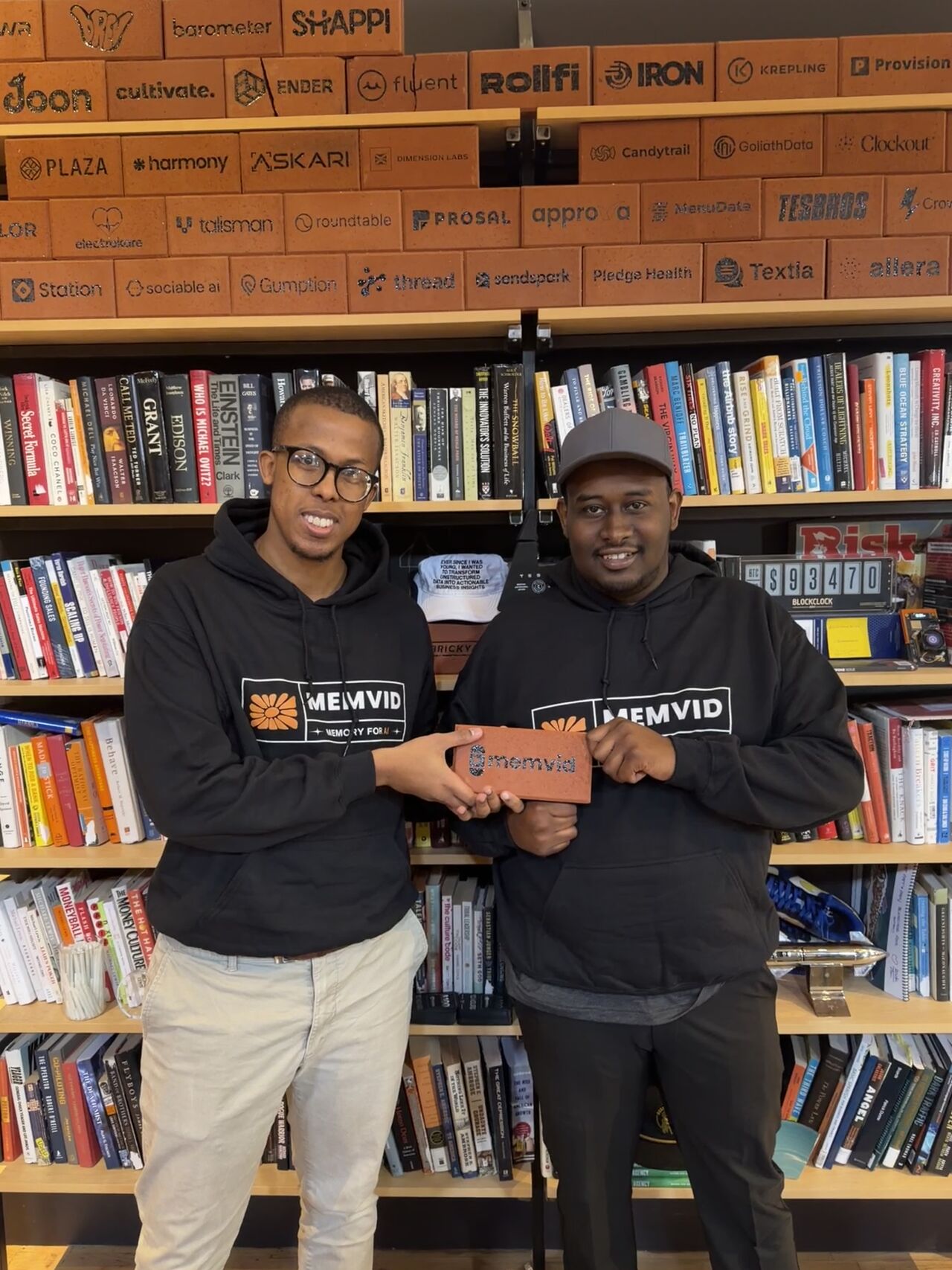
Mohamed Mohamed (left) · Saleban Olow (right)
Founders
Mohamed Mohamed (left)
Chief Executive Officer (CEO)
Saleban Olow (right)
Chief Technology Officer (CTO)
Brand Assets


Media Inquiries
For press inquiries, interview requests, or additional information, please contact our team.
Contact Uscontact@memvid.com